-
Menu
- Home
-
Categories
-
- Go to wholesale shop
-
SOLD ITEMS
-
-
SOLD ITEMS
-
-
Blog categories
- THE VANISHING TATTOO TRADITIONS OF MYANMAR (BURMA) (0)
- THE ETHNIC EARRINGS OF HILL TRIBES (0)
- LAHU (MUSUR) TRIBE AND THEIR LIVING HERITAGE (0)
- THE KAREN TRIBES AND THEIR LIVING HERITAGE (0)
- THE DAYAK: GUARDIANS OF BORNEO'S HERITAGE (0)
- THE LIVING SYMBOLS OF TIBET: TRADITIONAL JEWELRY AND EARRINGS (0)
- TRADITIONAL BRE (KAREN SUB-GROUP) ALUMINUM EAR TUNNELS – KARENNI STATE, BURMA (MYANMAR) (0)
- THE PYU CIVILIZATION: MYANMAR’S FORGOTTEN PIONEERS (0)
- TURKMEN FIRE-GILDED SILVER CUFFS: A TIMELESS SYMBOL OF CENTRAL ASIAN HERITAGE (0)
- THE YUAN PEOPLE OF NORTHERN THAILAND: HISTORY, CULTURE, AND LIVING HERITAGE (0)
- THE THAI YAI PEOPLE OF MEAWADEE (0)
- LEMBATA ISLAND – INDONESIA (0)
- METALS - THEIR KINDS & USE IN ANCIENT S.E ASIAN JEWELRY (0)
- PALM-LEAF MANUSCRIPTS OF SOUTHEAST ASIA (0)
METALS - THEIR KINDS & USE IN ANCIENT S.E ASIAN JEWELRY
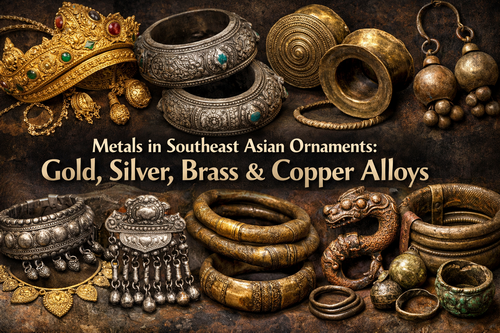
[IMAGE FOR ILLUSTRATION PURPOSES ONLY]
Metals in Southeast Asian Ornaments: Materials, Meaning, and Survival Through Time
Across Southeast Asia and neighboring regions — including Indonesia, Vietnam, Cambodia, Myanmar, and China — people have shaped ornaments, jewelry, and ritual objects from metal for over two thousand years.
From early bronze-working cultures (c. 1000 BCE) through pre-modern kingdoms and into the 19th–early 20th century, material choice reflected access to resources, trade routes, social meaning, and everyday function.
Silver was important — but it was never the only metal. Gold, brass, bronze, and copper alloys were widely used for body ornaments, ritual objects, and tools of adornment across different regions and periods.
The Main Metals Used (Simple, Historical Overview)
Gold
-
Periods: Early kingdoms to pre-modern courts (c. 1st millennium CE–19th century)
-
Where: Royal and temple contexts in Cambodia, Java (Indonesia), mainland courts in Myanmar and Vietnam
-
What it meant: Sacred authority, divine kingship, spiritual power
-
Why it was chosen: Corrosion resistance, ritual purity, high prestige
-
How it was used: Court jewelry, temple offerings, elite ornaments
Key idea: Gold was rare in everyday life. It marked royalty, ritual, and sacred power, not daily identity.
Silver
-
Periods: Pre-modern trade era to colonial period (c. 15th–early 20th century)
-
Where: Upland mainland Southeast Asia and trade-connected regions
-
What it meant: Portable wealth, family status, ritual value
-
Why it was chosen: Bright color, value retention, workable softness
-
How it was used: Heirloom jewelry, dowry items, ceremonial ornaments
Key idea: Silver functioned as wearable wealth and social signal.
Brass (Copper + Zinc)
-
Periods: Pre-modern to early modern (c. 1000 CE–20th century)
-
Where: Widely used across Indonesia, Vietnam, Cambodia, and Myanmar
-
What it meant: Practical beauty, durability, everyday identity
-
Why it was chosen: Easy to cast, affordable, golden appearance
-
How it was used: Ear plugs, bracelets, rings, amulets, ritual fittings
Key idea: Brass looked precious, lasted long, and was available to most people.
Bronze & Copper Alloys
-
Periods: Ancient to pre-modern (c. 1000 BCE onward)
-
Where: Early metalworking centers in Vietnam and China; widespread across mainland and island Southeast Asia
-
What they meant: Continuity, protection, tradition
-
Why they were chosen: Locally smelted, strong, culturally familiar
-
How they were used: Body ornaments, bells, pendants, ritual tools
Key idea: Many ancient and pre-modern ornaments were copper-based, not silver or gold.
Why Different Metals Were Chosen
Material choice was not only about “value.” It reflected:
-
Availability: Local ore sources and trade access
-
Trade routes: River and overland networks bringing silver and gold to certain regions
-
Durability: Copper alloys and brass withstood daily wear
-
Symbolism:
-
Gold = sacred authority
-
Silver = wealth and social standing
-
Brass/copper = protection, continuity, everyday identity
-
-
Craft tradition: Casting and hand-finishing techniques passed through generations
In many communities, form, symbolism, and lived use mattered more than metal purity.
Everyday Life, Status, and Spiritual Practice
-
Everyday life: Brass and copper alloys dominated daily body adornment.
-
Status display: Silver signaled trade access and family wealth.
-
Sacred and court life: Gold marked ritual power and elite authority.
Ornaments shaped how people presented themselves socially and spiritually — they were part of identity, not fashion alone.
Survival Through Time: Patina as Historical Record
These metals survive because they change:
-
Gold remains stable, often preserving original form
-
Silver darkens with patina
-
Brass and copper alloys develop brown, red, and green corrosion layers
-
Wear marks show skin contact and long-term use
-
Tool marks reveal casting and hand-finishing methods
These surfaces are evidence of life with the object, not defects.
Patina and wear allow ornaments to be rediscovered centuries later as cultural witnesses.
What This Teaches Us Today
-
Silver was never the only or default material in Southeast Asian ornaments.
-
Gold marked sacred and elite contexts, not everyday wear.
-
Brass and copper alloys carried daily life, ritual continuity, and cultural identity.
-
The true value of these objects lies in craft, symbolism, and lived tradition, not only in precious metal content.
Southeast Asian metal ornaments reflect access to resources, trade, and cultural meaning across centuries. Gold marked the sacred and the royal; silver carried wealth and status; brass and copper alloys carried everyday life. What remains on their surfaces today — patina, wear, and tool marks — is the record of how people lived with these objects.
No posts found